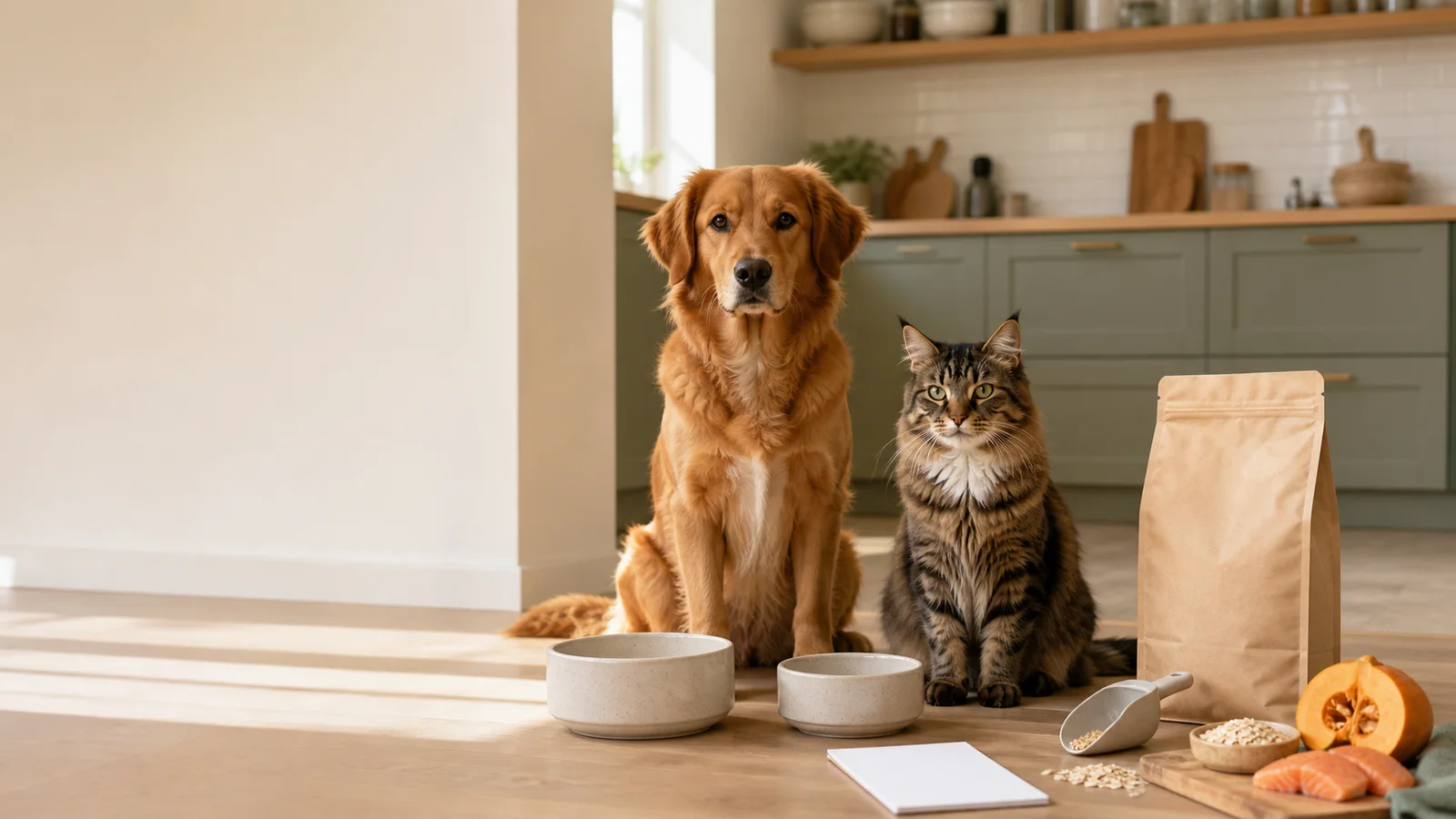
Open Farm sells dog and cat food in multiple formats, so the useful comparison is not simply whether one recipe sounds appealing. A careful choice starts with the animal’s species and life stage, the package nutritional-adequacy statement, calorie density, recipe format, feeding directions, ingredient information, storage needs, and the household’s ability to make a gradual transition.
Roy Collective has not independently tested Open Farm recipes, nutrient levels, palatability, digestibility, sourcing, or health outcomes. This guide organizes checks drawn from Open Farm’s current public transparency and customer-care pages plus U.S. Food and Drug Administration pet-food guidance. Recheck the actual package and current seller terms before ordering because recipes, availability, pricing, policies, and individual needs can change.
Who this may suit
Dog and cat owners who want a structured way to compare recipe formats, label information, feeding routines, lot-code traceability, and current order terms before choosing a food.
Roy Collective perspective
Start with nutritional suitability and a sustainable feeding routine, not ingredient marketing or a single front-of-pack claim. The right option is one that fits the animal’s species, life stage, health context, calorie needs, tolerance, and the owner’s storage, measuring, transition, and reorder plan.
Ready to review the current Open Farm offer?
Prices, inventory, eligibility, shipping, and terms can change. Confirm the complete current details on the advertiser’s website before purchasing.
Explore Open Farm pet food →What to compare before you buy
- Species, life stage, nutritional-adequacy statement, calorie content, and veterinarian guidance for individual health needs
- Dry, wet, freeze-dried, gently cooked, or other format; moisture, portion size, preparation, storage, and cost per feeding day
- Ingredient list, named protein sources, guaranteed analysis, sensitivities, package size, feeding directions, and lot code
- Transition plan, current shipping and return eligibility, recurring-order controls, availability, and a backup food plan
Start with species, life stage, and nutritional adequacy
Read the statement of nutritional adequacy on the exact package rather than assuming every recipe is intended as a complete daily diet. FDA guidance explains that a “complete and balanced” claim means the food is intended to serve as the sole diet and that its nutritional adequacy is supported by an AAFCO nutrient profile or feeding trial. The statement also identifies the life stage or stages for which the food is represented.
Match that statement to the animal in front of you: dog or cat, growing or adult, pregnant or nursing, and any condition being managed with professional guidance. Treats, toppers, mixers, and supplemental products may have a different intended role. If the animal has a diagnosed condition, unexplained symptoms, weight concerns, allergies, or a prescribed diet, ask the veterinarian before changing food.
Compare recipe formats and labels on the same basis
Different formats can look difficult to compare because their moisture levels, serving volumes, and calorie densities differ. Record calories per cup, can, package, ounce, or kilogram as stated on each label, then estimate the daily amount using the current feeding guide as a starting point. Do not compare guaranteed-analysis percentages across very different moisture levels as if they were directly equivalent.
Review the ingredient list in descending order by weight, the guaranteed analysis, named protein sources, package size, preparation instructions, and storage rules. An attractive ingredient list does not by itself prove suitability or a health outcome. Make sure the format can be measured consistently, stored safely after opening, and reordered without forcing abrupt switches.
Plan the transition, portions, storage, and monitoring
Open Farm’s current customer-care guidance recommends a gradual transition over one to two weeks. Build the schedule before the first serving and keep enough of the existing food to avoid rushing. Measure portions with the same tool each day, include treats and toppers in the overall intake, and adjust only with attention to body condition, activity, age, and veterinary advice.
During the transition, observe appetite, stool, vomiting, itching, energy, and weight without treating normal variation as a diagnosis. Stop and contact a veterinarian promptly for serious, persistent, or concerning symptoms. Follow the package instructions for refrigeration, resealing, thawing, serving, and discard timing; those details can differ substantially by format.
Use traceability and verify current order terms
Open Farm’s transparency page says products can be traced using a unique lot code and explains where that code appears on different package formats. Keep a photo of the front, ingredient panel, nutritional statement, best-before date, and lot code when opening a new package. That record is more useful than relying on an order name alone if a quality, recall, or customer-service question arises.
Before checkout, verify the exact recipe, size, quantity, delivery destination, current shipping charge and timing, recurring-order setting, cancellation controls, and return or satisfaction-process eligibility. Open Farm’s public policy describes conditions and time limits, so do not assume every opened product or purchase channel qualifies. Keep the confirmation and use a backup feeding plan in case availability changes.
Final pre-purchase checklist
- Confirm dog or cat, life stage, nutritional-adequacy statement, and any veterinarian-directed dietary requirements.
- Compare calorie density, moisture, daily portion, package size, storage, and estimated cost per feeding day.
- Read the ingredient list, guaranteed analysis, feeding directions, preparation instructions, and lot-code location.
- Keep enough current food for a gradual one-to-two-week transition and measure each portion consistently.
- Record the package, best-before date, and lot code, and monitor appetite, stool, weight, skin, and energy appropriately.
- Verify live price, stock, shipping, recurring-order, cancellation, and return eligibility before checkout.
Frequently asked questions
Does every Open Farm product count as a complete daily diet?
Do not assume so. Check the nutritional-adequacy statement on the exact package to see whether it is complete and balanced, the intended species and life stage, and whether it is a treat, topper, mixer, or supplemental product.
Can guaranteed-analysis percentages be compared directly across dry and wet foods?
Not always. Moisture can differ substantially, so as-fed percentages can mislead. Use calorie information and ask a veterinarian how to compare nutrients on an appropriate basis for the animal’s needs.
How quickly should I change foods?
Open Farm currently recommends transitioning gradually over one to two weeks. Individual circumstances differ, so follow veterinary guidance when the animal has health issues or reacts poorly.
Why should I save the lot code?
It identifies the production lot and can help with traceability, customer-service questions, or recall checks. Photograph it with the package and best-before information.
Ready to review the current Open Farm offer?
Prices, inventory, eligibility, shipping, and terms can change. Confirm the complete current details on the advertiser’s website before purchasing.
Explore Open Farm pet food →Additional references: Open Farm ingredient and lot-code transparency · Open Farm shipping, transition, and satisfaction guidance · FDA complete and balanced pet-food guidance · FDA animal-food labeling and pet-food claims